

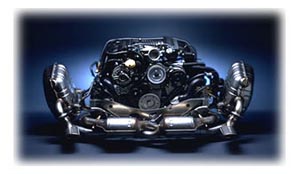
 The first of the New 911's numerous advancements is situated in the
time-honored location behind the rear wheels -- a 3.4-liter
water-cooled flat-six engine. With its unique cross-flow cooling system, each head and
cylinder has its own water circuit to ensure all run at the
same temperature to extract the highest level of power. Exploiting the
increased cooling capacity are dual overhead cams and four valves per
cylinder, helping boost output to 296 horsepower and 258 lb-ft of
torque. Simultaneously, noise and emissions are reduced to levels meeting
standards well into the next century.
The first of the New 911's numerous advancements is situated in the
time-honored location behind the rear wheels -- a 3.4-liter
water-cooled flat-six engine. With its unique cross-flow cooling system, each head and
cylinder has its own water circuit to ensure all run at the
same temperature to extract the highest level of power. Exploiting the
increased cooling capacity are dual overhead cams and four valves per
cylinder, helping boost output to 296 horsepower and 258 lb-ft of
torque. Simultaneously, noise and emissions are reduced to levels meeting
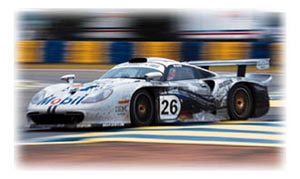
standards well into the next century.While it's the first dual-overhead-cam, four-valve-per-cylinder, water-cooled engine ever to power a production 911, its engineering has been perfected in Porsche racing cars for years. In fact, we've applied a lot of what we learn from racing. Like how to ensure the engine receives its life-blood oil in even the most extreme conditions. Those lessons have been applied to the new 911's powerplant in the form of an integrated dry-sump lubrication system. Like the water cooling circuits, the oil lines are cast into the all-aluminum block and heads, eliminating external lines that clutter the engine compartment and require regular repair or replacement. Even the oil-coolant heat exchanger is mounted directly to the block to negate the need for external piping.
 Porsche's exclusive VarioCam variable valve timing system adjusts the
inlet valve timing of the dual overhead cams for minimal emissions and
maximum power. It works in concert with a 2-stage resonant induction
system and Bosch Motronic engine management to optimize valve timing,
air induction, ignition and fuel injection at all engine speeds. Not only
are you rewarded with more peak power, but more flexible passing power,
with no less than 220 lb-ft of torque on tap from 2700 rpm clear to 7000.
The Motronic management system even has individual knock sensing and
control for each cylinder to ensure the New 911's impressive power is
complimented by impeccable smoothness.
Porsche's exclusive VarioCam variable valve timing system adjusts the
inlet valve timing of the dual overhead cams for minimal emissions and
maximum power. It works in concert with a 2-stage resonant induction
system and Bosch Motronic engine management to optimize valve timing,
air induction, ignition and fuel injection at all engine speeds. Not only
are you rewarded with more peak power, but more flexible passing power,
with no less than 220 lb-ft of torque on tap from 2700 rpm clear to 7000.
The Motronic management system even has individual knock sensing and
control for each cylinder to ensure the New 911's impressive power is
complimented by impeccable smoothness.
So what hasn't changed about the engine? The way it's built, naturally. As is Porsche tradition, every 911 engine is hand assembled by a single technician personally responsible for every engine he builds. Each engine is then tested unforgivingly. To ensure horsepower and torque are at their appropriate levels, each engine is bench tested for up to 30 minutes, including a full minute nonstop at redline. A rolling road test simulates the requirements of driving. And, ultimately, the final road test lasts a full 90 minutes at the hands of a Porsche test driver.
Most importantly, every 911 retains the classic free-revving performance of a short-stroke Porsche engine. As well as that classic 911 sound.
 |
 |
 |
 |
 |
 |
 |